IESCO Tariff 2026 in Pakistan – Latest Unit Prices & Slabs
As an IESCO customer, understanding how the IESCO Tariff 2026 works will allow you to control your electrical usage and significantly reduce your electricity costs.
This guide explains the following areas: Tariff 2026 and 2025, the old or previous rates; IESCO Tariff 2026, the new updated rates; price per unit; and how to access your electric bill online.
What Is the IESCO Tariff 2026?
The IESCO Tariff 2026 is the pricing structure used by IESCO to determine the charge for each 1 unit = 1 kWh (kilowatt-hour) of electricity you consume within a single month. The meter measures the amount of electricity consumed by counting units and uses the IESCO bill tariff to calculate your billing amount for the entire month. IESCO must follow the government guidelines set forth by the National Electric Power Regulatory Authority in order to calculate the billing amounts fairly.
IESCO Tariff 2025 and IESCO New Tariff 2026
In the IESCO tariff 2025, for many customers, electricity pricing was already on the higher side. In 2026, a few small changes were made by the government; this is known as the IESCO new tariff. These price increases occurred as the costs of producing electricity increased due to the increased cost of fuel.
Customers should also note that their average consumption rate may increase if they use the same amount of energy as last year, even if their total energy consumption is the same. Factors causing the increase include changes to the IESCO Tariff 2025 and the new system, and the potential impact of the 2025 changes on how your average consumption rate will change in 2026.
GOP Tariff Units IESCO Explained
The term GOP tariff units IESCO refers to the method that the Government of Pakistan established to categorize customers’ electricity consumption into categories called slabs. Each individual or business customer is placed into a level or slab according to their usage. The higher the electricity consumption range the customer falls into, the more costly the prices assigned for each unit. The objective of the slab regulation of consumption is to encourage conservation of electricity and allow the utility to provide electricity efficiently.
IESCO Tariff Rate and Unit Price
The tariff rate is described below:
- The tariff rate represents the retail cost of 1 unit of electricity. The unit price of electricity in Pakistan today (2026): there are no standard fixed charges.
- Rather, the electricity unit price varies according to usage amounts and consumer classifications.
- The domestic consumer tariff for IESCO (2026) applies a lower charge for the initial units consumed, then regular (higher) tariffs for subsequent units.
- Commercial users will typically pay more than residential users due to the duration of time each user utilizes the utility services.
- Many consumers want to identify their latest commercial electricity unit billing rates and therefore frequently search for the IESCO commercial unit price today.
IESCO Bill Tariff Structure
The structure is as follows:
- The IESCO electricity bill consists of more than just the unit billing cost. There are many different components of the final bill. The first component is the total number of units billed.
- Then, the IESCO Tariff 2026 unit billing rate, and finally, additional charges such as taxes, fuel price adjustments, and service charges.
- Additional bills can vary in total amount due to the addition of various charge components, yet remain consistent in the number of billed units. Establishing a solid foundation for understanding the full bill is vital for all consumers served by IESCO.
IESCO Bill Calculator Explained
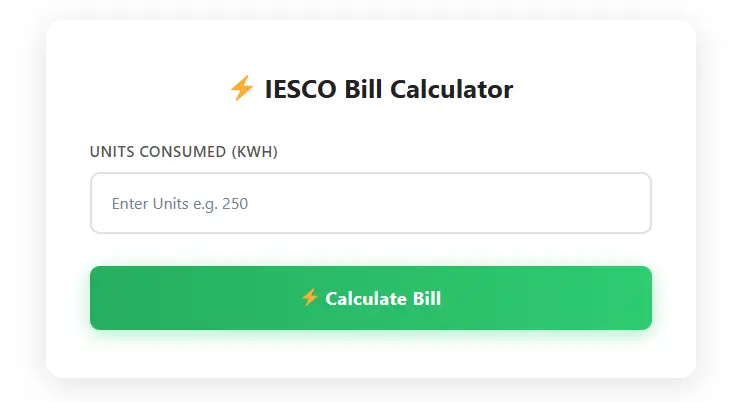
An IESCO bill calculator provides an estimate of how much you’ll need to pay for electricity when you receive your bill. The estimates are based on the number of units you’ve used until your actual bill arrives. Applying the IESCO Tariff Rates 2026 to the number of units you’ve used, plus additional expenses such as tax, will provide you with an approximate amount of your final bill. Most people use this to help them manage their electricity consumption appropriately and avoid unexpected large bills.
Electricity Unit Price in Pakistan Today 2026
The price for each unit of electricity you’ll pay in Pakistan will vary depending on several factors: the number of units you consume, what category you fall in, and what new regulations are outlined by the government. In IESCO Tariff 2026, the initial units consumed are less expensive, with each subsequent unit being more expensive. This type of tiered pricing helps limit unnecessary usage, thereby conserving energy. When individuals conserve energy by limiting how much they use, they can remain in the lower tiers of usage and therefore reduce their monthly bill.
IESCO Commercial Unit Price Today
IESCO business rates are higher than home rates. Daytime hours are when businesses (shops, offices, restaurants) use more than the normal amount of electricity; IESCO business rates are higher in 2026. All business owners should be aware of how the system works and reduce their costs by managing their electricity better so that they can increase their profits.
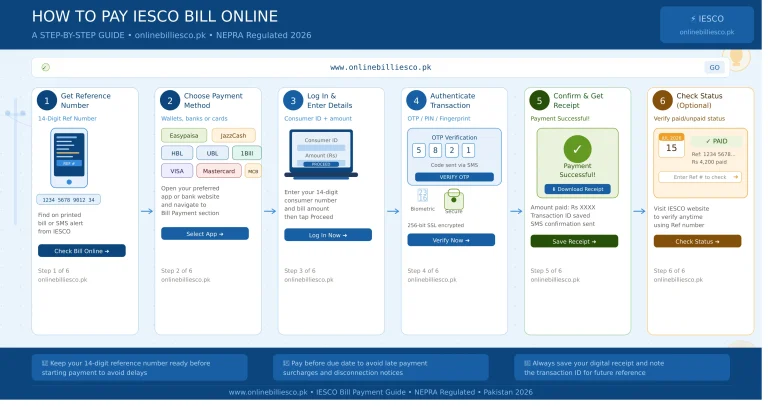
IESCO Online Bill Check 14-Digit
The method is explained below:
- The IESCO 14-digit bill reference system is designed to help you access your bill online quickly and easily.
- Your bill will always include a 14-digit bill reference number.
- All you have to do is enter this number into the IESCO website, and your bill will come up for you to download or print.
- This system allows you to save time by checking your bill without having to visit any offices.
How to Save Money on IESCO Tariff 2026
If you fully understand this guide, you can save by turning off lights and fans that are not being used, avoiding the use of high-wattage appliances for long periods, and checking your monthly unit usage to keep yourself in lower slabs. These small changes combined will help lower your electricity bill.
Conclusion
Understanding IESCO’s tariffs is important for every electricity customer. By understanding how you’re billed, you can evaluate how much to expect on your next electricity bill. You will soon be equipped with detailed knowledge of each of these areas in plain English, including: Tariff 2025, the new tariff being implemented by IESCO, how to calculate your IESCO bill, what the GOP fees are for your IESCO usage, how to check your IESCO account online using the 14-digit number, and what to expect from IESCO rates in 2026. You can estimate your bill with these rates or check your IESCO bill online.
Frequently Asked Questions
Q1: Are you aware of the current per-unit rate for IESCO?
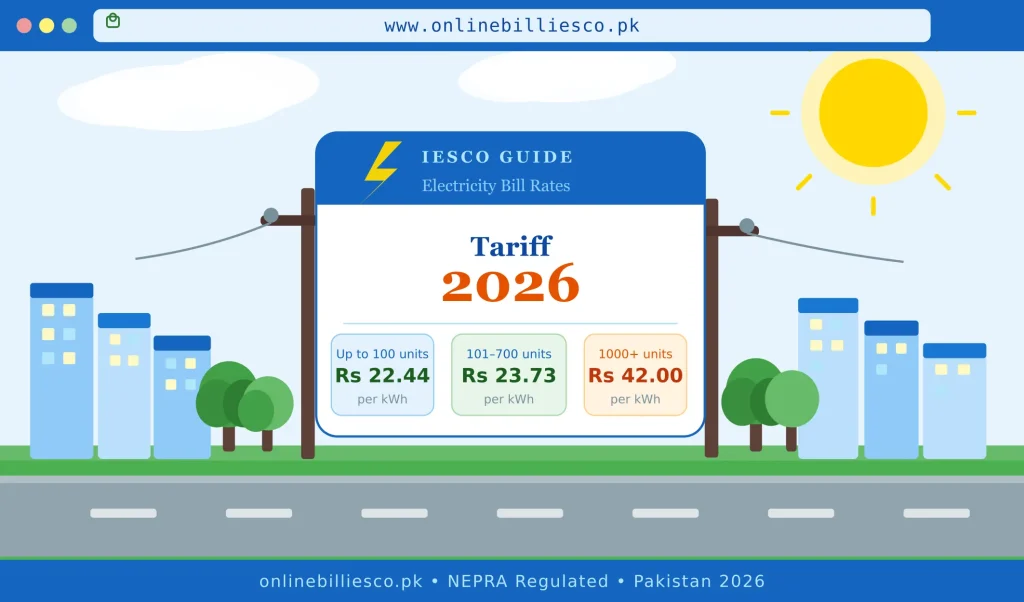
Ans: IESCO’s latest major/circuit breaker rates for domestic use: 1. The domestic rate is as follows: 100.000 square feet, 22.44 rupees for the first 100 residential units; the number may vary depending on the amount of electricity used under the bin: 700 kWhs to 1,200 kWhs. The maximum cost (including any additional variable charges) for large capacity users is 49.00 per kWh; there is also a fixed annual service charge based on kW*hour = Rs.360.00.
Q2: How do IESCO tariff slabs work?
Ans: The Government of Pakistan categorizes electricity consumption into slabs. Each customer is placed into a slab according to their usage, and the higher the consumption range, the more costly the price assigned for each unit. The initial units consumed are less expensive, with each subsequent unit being more expensive, which helps limit unnecessary usage and conserve energy.
Q3: How much does one unit of IESCO electricity cost?
Ans: The cost per unit depends on how much electricity is used per month. If less than 1000kWh is used, the charge is Rs 23.73/kWh. On the other hand, if 1000kWh is used, the charge is Rs 42.00/kWh.
Q4: As a residential customer, how much will I owe for electrical power consumption of 1,000 kWh?
Ans: For the next billing period (2025-2026), the average monthly bill with NEPRA regulations as a residential customer is expected to be around Rs. 42,000 – 50,000 per month; therefore, if you use 1,000kWh of power (which exceeds your monthly threshold of 700kWh), your electric power consumption will be billed at the maximum rate, not less than Rs. 42.00/kWh, including the various taxes and other costs associated with your power usage. Your total electric power cost or consumption will depend on the following taxes on your utility service: Federal Tax, NEPRA Tax, Fuel Price Adjustment (FPA) and fixed costs associated with your utility service.